The Problem With "Available" in the Open Market
When DigiKey, Mouser, and Arrow are out of stock, purchasing teams turn to the independent market. That market is real and legitimate — but it's unfiltered. Any company can call itself an electronic components distributor. The quality controls that define an authorized distributor don't automatically apply.
The checklist below is what a rigorous quality team runs through before placing an order with an independent source. It's not exhaustive, but covering these points eliminates most of the risk.
1. Verify the Distributor's ISO 9001:2015 Certification
ISO 9001:2015 certification means a documented quality management system has been audited and certified by an accredited third-party body — not self-declared. Ask for the certificate. It should show the certification body (an ANAB or UKAS-accredited registrar), the scope of certification, and a valid expiry date.
A distributor without ISO 9001:2015 has no independent verification that their quality processes work. Their inspection claims are marketing.
2. Confirm Active ERAI Membership
ERAI maintains the world's largest database of suspect-counterfeit electronic components and tracks distributors with histories of quality problems. Membership is verifiable directly on ERAI.com — don't take the distributor's word for it. Check yourself.
An ERAI member has access to live alerts on flagged part numbers and is integrated into the industry's primary counterfeit intelligence network. A non-member is flying blind.
3. Ask for the Lot's Traceability Chain
Where did this specific lot come from? A legitimate independent distributor can tell you: "We purchased this lot from [manufacturer / authorized distributor / end-user] on [date], and here is the supporting documentation." They may not always be able to share the supplier's name for business reasons, but they should be able to describe the supply chain and provide documentation.
If the answer is "we can't tell you where it came from," walk away.
4. Verify the Date Code Against Known Production History
Every component has a date code — a four-digit stamp indicating the year and work week of manufacture (YYWW format). For an obsolete part, the date code must fall within the manufacturer's actual production window.
- A date code that post-dates the last known production run is strong evidence of a remarked (relabeled) device
- Multiple date codes within a supposed single lot suggests mixed inventory — parts from different sources combined and represented as one lot
- Date codes that don't match the supplier's documentation are a hard stop
5. Check the Packaging
Original manufacturer packaging — sealed reels, trays, or tubes with intact labels — is a positive indicator. It doesn't guarantee authenticity, but it's consistent with legitimate provenance. Signs to look for on the other side:
- Repackaged into generic tubes or bags with hand-written labels
- Humidity moisture barrier bags that have been previously opened and resealed
- Mixed quantities from what's claimed to be a single manufacturer reel
- Labels that don't match the manufacturer's known label format for the period
6. Request a Certificate of Conformance Before the Purchase Order
A Certificate of Conformance documents the part number, quantity, lot information, and the distributor's quality statement. Ask to see a sample CoC before you commit to the purchase — it tells you what the distributor will and won't stand behind. A distributor who won't provide a CoC is not a distributor you should be buying from.
7. For High-Stakes Applications: Specify Lab Testing
For components going into defense, aerospace, medical, or safety-critical applications, specify independent laboratory testing as a condition of purchase. XRF analysis, X-ray imaging, and electrical verification by an accredited lab are the highest-confidence authentication methods available. Build the cost into the purchase price if needed — it's always less than the cost of a field failure.
8. Check GIDEP for Alerts on the Part Number
The Government-Industry Data Exchange Program (gidep.org) maintains reports on suspect and confirmed counterfeit components. A search on the specific part number and manufacturer before you buy is a 5-minute step that can prevent a serious problem. GIDEP participants — distributors and end-users who are registered — can also receive alerts proactively.
The Quick Version
ISO 9001:2015 certificate → ERAI membership verified → lot traceability chain → date code within production window → original packaging → Certificate of Conformance → lab testing for high-stakes lots → GIDEP check on the part number. Cover these eight points and you've done your due diligence on an independent market purchase.
RH Electronics covers all eight for every lot we buy. See our quality program, or submit a quote request for your hard-to-find part.
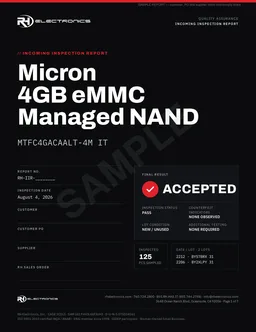
Twenty-one checks, nine photographs and a signed disposition on a lot of Micron eMMC — walk through the sample report →