How to Detect Counterfeit Electronic Components
The crude fakes with smeared logos still exist, but they're not the ones that hurt you. The dangerous counterfeits are good — a recycled die sanded and remarked to a higher grade, a commercial part relabeled as mil-spec, a package with nothing inside. No single test catches all of it, which is why authentication is built in layers.
Counterfeit detection isn't one test you pass or fail. It's a stack of methods, each closing a gap the one before it can't see — and each more expensive and more destructive than the last. A disciplined distributor doesn't run all of them on every part; it scales the depth of inspection to the risk of the part and the demands of the application. To understand the detection, it helps to first understand exactly what's being detected.
What You're Actually Up Against
"Counterfeit" covers several distinct frauds, and they don't all get caught the same way:
Recycled / used
Devices pulled from scrapped boards, cleaned, re-tinned, and sold as new. Often functional — but aged, stressed, and undocumented.
Remarked ("blacktopped")
The original surface is sanded or coated, then re-laser-marked to a higher grade, faster speed, or newer date code.
Relabeled
A genuine but lower-spec or entirely different part passed off as the one ordered — commercial sold as industrial or mil-spec.
Empty / non-functional
A correctly marked package with no die, the wrong die, or a dead one. Passes a visual check; fails only under power.
Cloned
Unauthorized copies built to mimic the original's marking and package, with unknown materials and reliability.
The Detection Stack, Layer by Layer
Run roughly cheapest-to-costliest, each layer is chosen because it sees something the previous can't:
1. External visual + high-magnification microscopy
Surface texture, marking alignment and font, logo accuracy, lead and pin condition, and tell-tale signs of sanding, re-tinning, or prior solder. A surprising share of fakes fail here under enough magnification.
2. Marking-permanency testing
A controlled solvent wipe checks whether the part marking smears, lifts, or dissolves. Genuine laser or ink markings resist it; a re-marked, re-coated surface frequently doesn't. It's one of the classic blacktop tells.
3. Dimensional checks & X-ray
Package dimensions are measured against the datasheet. X-ray looks inside without opening the part — revealing die size, lead frame geometry, and bond wires, or exposing an empty cavity where a die should be.
4. Decapsulation
Chemically opening the package to expose and verify the die: its dimensions, its die markings, and that it matches the manufacturer and part claimed on the outside.
5. Electrical test
Confirming the device actually performs to its datasheet parameters — the layer that catches functional fakes a visual inspection would clear.
6. XRF & FTIR material analysis
X-ray fluorescence verifies lead-finish and material composition; FTIR analyzes surface chemistry to detect resurfacing compounds used to hide remarking.
At RH Electronics, the front-line layers — documentation and provenance review, high-magnification microscopy, and marking-permanency checks — are performed in-house on receipt under our ISO 9001:2015 quality system. The advanced analysis — XRF, FTIR, X-ray, decapsulation, and electrical test — is sent to accredited independent laboratories, so the results stay impartial and the testing carries no stake in the sale.
Why Provenance Is the First Line of Defense
Here's the uncomfortable truth about testing: you can't fully test a reel. Destructive methods like decapsulation consume the part, so inspection samples a lot — it doesn't clear every piece. That's why where a part came from matters as much as what a microscope shows. A traceable supply chain, a known source, and ERAI and GIDEP intelligence flagging suspect lots and suppliers all lower the odds before a single part is opened. Testing confirms; provenance prevents. The strongest programs lean on both.
Need a part authenticated to a specific level?
Tell us the part and your risk tolerance — we'll match the inspection to it.
The Bottom Line
There's no magic counterfeit test — there's a process, layered from fast-and-cheap to deep-and-destructive, scaled to the part and the stakes, and anchored by a supply chain you can trace. Get both right and the independent channel becomes a safe place to buy the parts the authorized channel no longer carries.
See RH Electronics' full quality and inspection process, or submit a requirement.
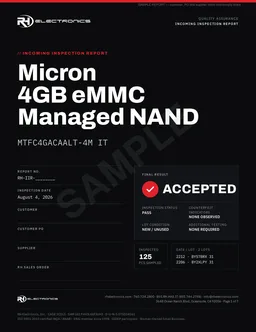
Twenty-one checks, nine photographs and a signed disposition on a lot of Micron eMMC — walk through the sample report →